
In this example, VMF is applied in brewery operations, where it has the potential to be used in a range of applications and can replace a variety of conventional technologies such as High Speed Separators (HSS), with both qualitative and economical benefits.
Description:
VMF combines 3 unique separation features that enables improved separation processes and multi-purpose use in brewery operations:
- Handling high solid loads and viscosities
- High transmission of essential beer components, e.g. aroma compounds and foam proteins, due to unique separation process control
- Low shear process
VMF is applicable both for micro breweries and large-scale industrial size breweries. It can be used in any kind of separation, filtration, concentration, clarification, diafiltration etc. process such as:
- Wort separation (lautering)
- Wort recovery (trub filtration)
- Cold trub separation
- Yeast harvesting and yeast beer recovery
- Green beer filtration/tank bottom filtration
- Beer recovery
- Spent grain filtration
- Beer clarification
- Waste-water treatment
- Filtration of stabilized beer (separation from single-use stabilizers such as PVPP or silica gel)
It can also be used for many kinds of end products such as beer, wine or other fermented beverages; for many kind of feed or fermentation, like yeast, bacteria or any other cell-based media; and can furthermore be added steps in between the presented steps, for example in cell lysing, chemical extraction, pH change etc.
The very same solutions with the same benefits can be used for not fermented processes such as proteins processed from grains.
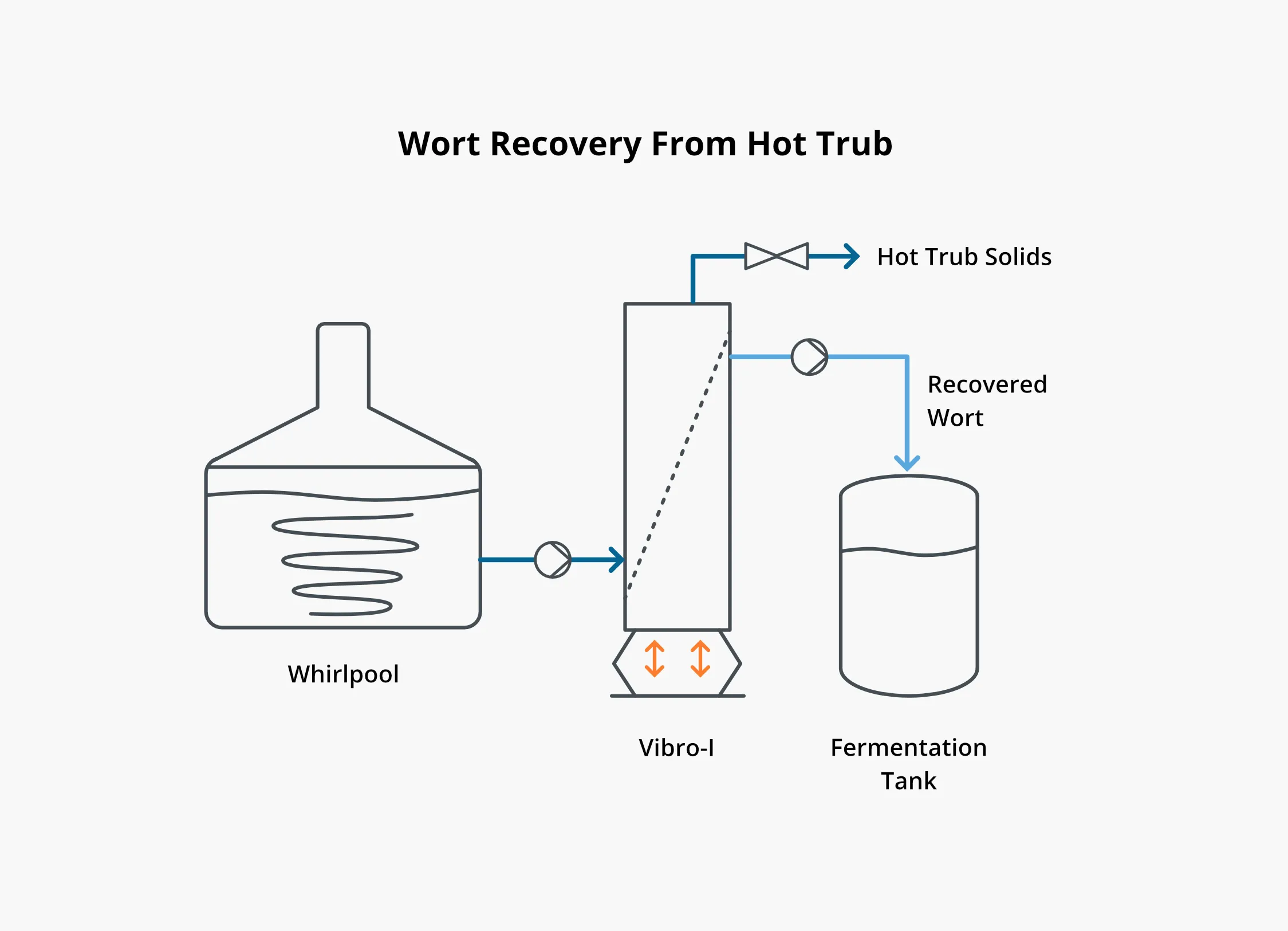
Wort Recovery From Hot Trub
After whirlpooling, considerable amounts of wort/extract is contained in the so called hot trub, which can be recovered, increasing brewhouse yields. This is currently done with decanters, HSS or similar, however with VMF we present an exciting alternative with many benefits:
- Lower CAPEX/OPEX
- Improved Brewhouse yield
- Improved colloidal stability of the recovered Wort, increasing cold break formation and improve filterability of finished beer during a later clarification step

Wort Recovery From Cold Trub
Upon cooling the wort (< 60°C), so called cold trub forms from precipitation of polyphenol/tannin and protein complexes. These tiny particles (0.5 μm) adhere to yeast cells, lowering the surface area in contact with the fermenting wort, decreasing fermentation efficiency. This is especially important for yeast which is reused for multiple brews. Furthermore, removal of cold trub will have the following benefits:
- Foam improvement (Precipitation of fatty acids)
- Flavour stability
- More intense fermentation
- Rounder beer flavour (more pleasant bitterness)

Green Beer Recovery
Once beer has finished primary fermentation, a period of maturation is required, which can be done in either the fermentation vessel (Unitank process) or a Maturation tank (2 tank process). This is done for multiple reasons, one being to settle the yeast still in suspension to clarify the beer before final filtration. This requires extensive cooling (< 0°C) and is time consuming, especially with large fermentation tanks. To facilitate this process, HSS, decanters or similar is currently used. However, these are expensive and has high energy requirements. With VMF we propose a more energy efficient solution, while being cost competitive.

Yeast Harvesting and Yeast Beer Recovery
Surplus yeast is harvested for later use at the end of primary fermentation. When reusing yeast, it is crucial that the yeast is in good condition, meaning yeast with a high viability and high vitality. This is done by minimizing the shear forces applied to the cells, to keep it alive and healthy.
The harvested yeast slurry contains so called yeast-beer, which is often of lower quality than the actual beer. Yeast beer can account for as much as 5% of the total beer output, and therefore the overall yield can be vastly increased if this beer is recovered and blended with sales beer or fermenting wort. If yeast beer of very high quality is obtained, it can have as much value per hl as actual sales beer, which is why brewers can benefit economically from the recovery of this by-product.
Traditionally yeast beer is recovered using centrifuges or other separators, but since these are expensive in CAPEX/OPEX and that the yeast beer often requires additional clarification/filtering before use, this operation is inefficient.
With the Vibro® technology, the yeast can be harvested and reduced to a desired concentration with a desired DM%, depending on if it is to be reused for beer production or dried and sold as feed.
Yeast with a high viability due to the low shear forces applied by the Vibro® units is harvested and this will improve its performance in future fermentations, leading to healthy beer fermentations and thus great quality beer without off-flavours
Compared to yeast beer recovered by separators, the VMF permeate will have excellent clarity eliminating the need for additional processing steps before blending the yeast beer with sales/fermenting beer

Clarification and Tank Bottom Recovery
By the end of maturation, beer needs to be clarified and the tank bottoms needs to be removed, from where additional beer can be recovered. This is traditionally performed using a HSS or Decanter followed by either DE or Crossflow Membrane filtration, however VMF is a promising alternative with lower energy consumption, replacing both these operations:
- Since the Vibro® technology can handle high solid loads, the need for a multiple step separation process is eliminated.
- With the low uniform TMP achievable, crystal clear beer can be obtained, while retaining key beer components such as flavour molecules and foam proteins
In the case of DE filtration, several steps such as precoating and continous DE dosing steps are required, and furthermore the DE used is carcinogenic and has a high impact on the environment. Conventional Crossflow Membrane filtration systems require a prior step of mechanical separation by means of a e.g. HSS.
VMF enables a simpler, greener and more efficient beer clarification process, while being cost competitive and produces beer of excellent clarity and quality.
