
DYNAMIC, VIBRATION-bASED FILTRATION
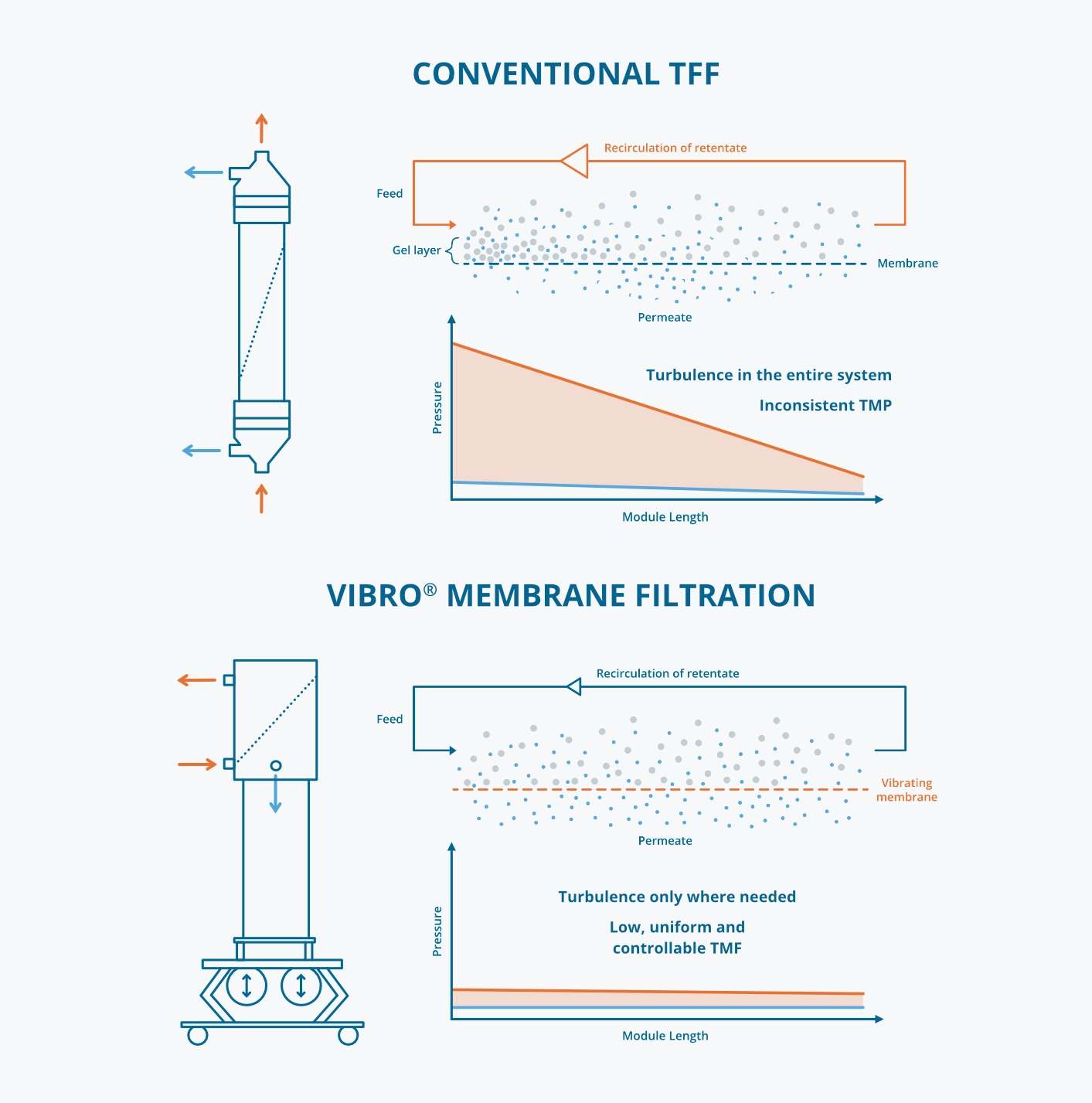
By generating turbulence directly at the membrane surface through controlled vibrations, Vibro® systems efficiently mitigate fouling – independent of crossflow.
This enables new ways of processing, with lower fouling and shear and higher yields, all within a linearly-scalable, fully drainable and energy-efficient design.

DYNAMIC ANTI-FOULING
The Vibro® anti-fouling mechanism localises turbulence at the membrane surface and minimizes build-up. This supports longer run times and more consistent performance.

Uniform, controllable TMP
VMF maintains a uniform, adjustable TMP across the entire membrane area. This enables precise process control, higher transmission and sharper separations.

OPEN, drainable design
VMF’s open, easy-to-clean Free Flow Plate™ modules make it possible to process highly concentrated, viscous media. The fully drainable design maximizes product recovery.

LOW SYSTEM SHEAR
VMF mitigates fouling through targeted vibrations rather than high feed velocity. As a result, overall system shear stress is significantly reduced, helping preserve product quality.

MODULAR, SCALABLE DESIGN
VMF mitigates fouling through targeted vibrations rather than high feed velocity. As a result, overall system shear stress is significantly reduced, helping preserve product quality.

Energy Efficiency
Lower feed velocities and minimal pressure loss significantly reduce energy requirements. This makes the Vibro® technology a sustainable choice for modern bioprocessing.
How Vibro® Membrane Filtration (VMF) Works
Linearly scalable from lab to industrial scale
Vibro® Membrane Filtration (VMF) is linearly and seamlessly scalable from lab to industrial production, making it suitable for both the smallest research and test applications with a feed volume of no more than 20 mL as well as large industrial operations.
MODULAR DESIGN
VMF offers consistent performance from lab to industrial scale, with a modular design that ensures predictable results and minimizes process adjustments.

FDA- and gmp-compliant
All VMF solutions meet regulatory standards in pharma and biotech, thereby facilitating faster process validation and approval.

SIMPLE OPERATION
VMF is very easy to set up and use, which reduces operator errors and improves process consistency while scaling.
Lab-Scale Vibro® Solutions
FLEXIBLE & ADAPTABLE
VMF is compatible with various process fluids and viscosities as well as easy to integrate with and adapt to existing systems, which accommodates diverse bioprocessing needs and future process changes.

SMARTER FACILITY DESIGN
VMF optimizes and intensifies downstream processing and can even replace certain steps such as centrifugation, resulting in fewer units and a streamlined, easier-to-scale design.
Industry-Scale Vibro® Solutions
VIBRO® TECHNOLOGY in Micro- and ultrafiltration


HOW VMF IMPROVES Micro- And Ultrafiltration
Lower Fouling & Stable Operation
Vibrations cause localized turbulence at the membrane surface, minimizing build-up and supporting longer run times as well as consistent performance.
Uniform TMP
The elimination of significant pressure drop across the module known from conventional TFF ensures consistently high separation performance and precise process control.
Gentle Processing
Lower overall system shear reduces the risk of protein denaturation and aggregation as well as unintended cell lysis, resulting in higher yields and reduced burden on downstream purification.
Energy Efficiency
By replacing high cross-flow velocities with vibration, VMF can reduce energy consumption by up to 95%, making it a highly efficient and environmentally friendly ultrafiltration solution.
High Viscosities & Concentrations
VMF’s low flow rates and open channel design make it ideal for handling highly concentrated and/or viscous media.
Higher Yield & Transmission
VMF’s fully drainable design and gentle product handling maximize product recovery, while its uniform TMP delivers unmatched product transmission.
Frequently asked questions
How does Vibro® technology differ from conventional cross-flow filtration methods?
Vibro® technology generates localized turbulence at the membrane surface using controlled vibration, which reduces the need for high-velocity flow and high-pressure drops required by conventional tangential flow filtration. This creates gentler processing conditions and allows for more precise control over transmembrane pressure, leading to higher yields and lower fouling rates.
What are the main benefits of using Vibro® technology in membrane filtration?
The key benefits include higher product yields, uniform transmembrane pressure across the membrane, lower fouling, gentler processing conditions for sensitive biomolecules, potential elimination of certain process steps, and significant energy savings compared to traditional methods.
In what ways does Vibro® technology improve microfiltration and ultrafiltration processes?
Vibro® technology enables uniform membrane conditions, reduces shear stress, increases yield and transmission, minimizes fouling, and substantially lowers energy requirements in both microfiltration and ultrafiltration. For ultrafiltration, it specifically allows for continuous, stable operation and can enable single-pass processing.
Why is energy efficiency cited as a significant advantage of Vibro® membrane filtration systems?
Energy efficiency is achieved by eliminating the need for rapid liquid flows and large pressure drops, which are energy-intensive in conventional systems. Vibro® technology can reduce energy consumption by up to 95%, making it a sustainable and environmentally friendly solution for filtration applications.
How does the use of vibration in VMF affect the quality and stability of sensitive biological products?
By reducing shear stress through lower pump speeds and localized turbulence, Vibro® technology preserves the integrity of sensitive biomolecules and cells, thereby maintaining product quality and stability during filtration processes.
curious to learn more about Vibro®?
Book a demo or discuss your application with one of our filtration specialists today.
By filling in this form, you consent to receiving digital communications from Sani Membranes.