
E. coli Harvest & Wash and Lysate Protein Clarification & Recovery using Vibro® Membrane Filtration (VMF)
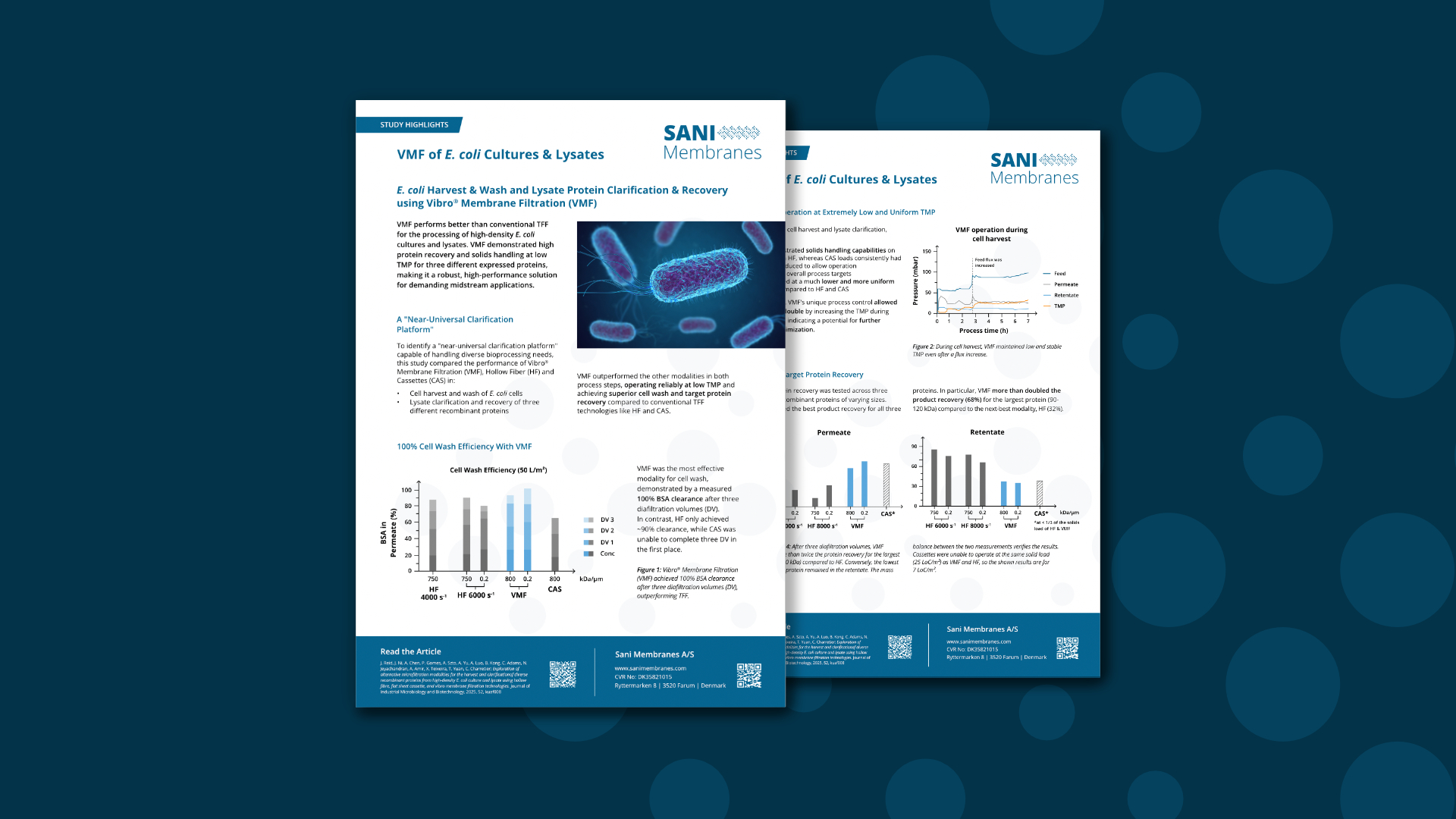
VMF performs better than conventional TFF for the processing of high‑density E. coli cultures and lysates. VMF demonstrated high protein recovery and solids handling at low TMP for three different expressed proteins, making it a robust, high-performance solution for demanding midstream applications.
A “near-universal clarification platform”
To identify a “near-universal clarification platform” capable of handling diverse bioprocessing needs, this study compared the performance of Vibro® Membrane Filtration (VMF), Hollow Fiber (HF) and Cassettes (CAS) in:
- Cell harvest and wash of E. coli cells
- Lysate clarification and recovery of three different recombinant proteins
VMF outperformed the other modalities in both process steps, operating reliably at low TMP and achieving superior cell wash and target protein recovery compared to conventional TFF technologies like HF and CAS.
100% Cell Wash Efficiency with VMF
VMF was the most effective modality for cell wash, demonstrated by a measured 100% BSA clearance after three diafiltration volumes (DV). In contrast, HF only achieved ~90% clearance, while CAS was unable to complete three DV in the first place.
Superior Target Protein Recovery
Lysate protein recovery was tested across three different recombinant proteins of varying sizes. VMF achieved the best product recovery for all three proteins. For the largest protein (90-120 kDa) in particular, VMF more than doubled the product recovery (68%) compared to the next-best modality, HF (32%).
Robust operation at extremely low and uniform TMP
During both cell harvest and lysate clarification, VMF:
- Demonstrated solids handling capabilities on par with HF, whereas CAS loads consistently had to be reduced to allow operation
- Met the overall process targets
- Operated at a much lower and more uniform TMP compared to HF and CAS
Additionally, VMF’s unique process control allowed the flux to double by increasing the TMP during diafiltration, indicating a potential for further process optimization.
Read the complete study
Exploration of alternative microfiltration modalities for the harvest and clarification of diverse recombinant proteins from high-density E. coli culture and lysate using hollow fibre, flat sheet cassette, and vibro membr ane filtration technologies
Jennifer Reid, Joyce Ni, Airong Chen, Patricia Gomes, Andrew Szto, Analyn Yu, Angela Luo, Belinda Kong, Calvin Adams, Neveathan Jeyachandran, Anumta Amir, Xavier Teixeira, Tao Yuan, Cédric Charretier
Journal of Industrial Microbiology and Biotechnology , 2025, 52, kuaf008