
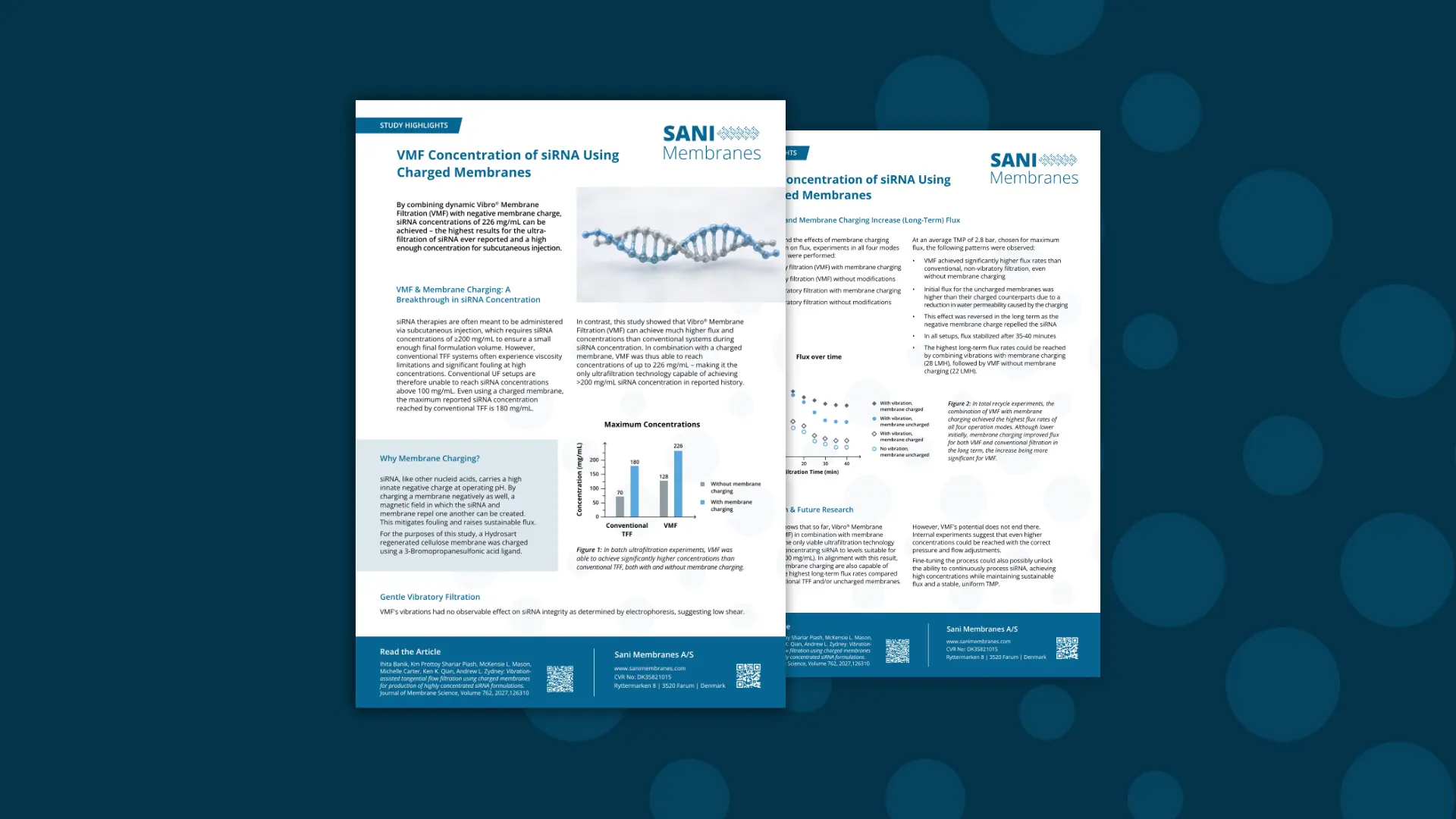
Vibro® Membrane Filtration (VMF) is currently the only ultrafiltration technology capable of reaching target siRNA concentrations. Where conventional UF systems continuously failed to reach concentrations of even 100 mg/mL, falling far short of the process target of 200 mg/mL—the minimum concentration necessary for subcutaneous injection—, VMF was able to achieve a maximum concentration of 226 mg/mL.
VMF & Membrane Charging: A Breakthrough in siRNA Concentration
Small interfering RNA (siRNA) therapies are often meant to be administered via subcutaneous injection, which requires siRNA concentrations of ≥200 mg/mL to ensure a small enough final formulation volume. However, conventional TFF systems experience viscosity limitations and significant fouling at high concentrations. Standard ultrafiltration (UF) setups are therefore unable to reach siRNA concentrations above 100 mg/mL. Even using a charged membrane, the maximum reported siRNA concentration reached by conventional TFF is 180 mg/mL.
In contrast, this study demonstrated that Vibro® Membrane Filtration (VMF) enables much higher flux and concentrations than conventional systems during siRNA concentration. In combination with a charged membrane, VMF was thus able to reach concentrations of 226 mg/mL – making VMF the only ultrafiltration technology capable of achieving the target siRNA concentration of >200 mg/mL ever reported.
“This study already demonstrates VMF’s immense potential for siRNA concentration and once again proves that VMF is more than just improved TFF—it’s an enabling technology. […] It’s likely that further optimization of the process parameters controlling VMF could contribute to even higher concentrations.”
Simon Bergmann, Senior Bioprocess and Application Specialist at Sani Membranes
Gentle Vibratory Filtration
VMF’s vibrations had no observable effect on siRNA integrity as determined by electrophoresis, suggesting low system shear.
Vibration and Membrane Charging Increase Flux
To understand the effects of membrane charging and vibration on flux, experiments in all four operation modes were performed: VMF with and without membrane charging as well as non-vibratory filtration with and without membrane charging.
The following patterns were observed:
- VMF achieved significantly higher flux rates than conventional, non-vibratory filtration, even without membrane charging
- In the long term, flux for the charged membranes was markedly higher than their uncharged counterparts as the negative membrane charge repelled the siRNA
- In all setups, flux stabilized after 35-40 minutes
- The highest long-term flux rates could be reached by combining vibrations with membrane charging (28 LMH), followed by VMF without membrane charging (22 LMH).
Why Membrane Charging?
siRNA carries a high innate negative charge at operating pH. If the membrane is also negatively charged, the siRNA and membrane start repelling one another. This mitigates concentration polarization and fouling and raises sustainable flux.
Conclusion and Future Research
This study demonstrates that Vibro® Membrane Filtration (VMF) is currently the only viable ultrafiltration technology capable of concentrating siRNA to levels suitable for injection (>200 mg/mL). VMF is also able to reach higher flux rates than conventional TFF.
However, internal expertise suggests that even higher concentrations could be reached with the correct pressure and flow adjustments. Fine-tuning the process could also possibly unlock the ability to continuously process siRNA, achieving high concentrations while maintaining sustainable flux.
READ THE ARTICLE
Vibration-assisted tangential flow filtration using charged membranes for production of highly concentrated siRNA formulations.
Ihita Banik, Km Prottoy Shariar Piash, McKensie L. Mason, Michelle Carter, Ken K. Qian, Andrew L. Zydney
Journal of Membrane Science, Volume 762, 2027,126310