
VMF vs. CONVENTIONAL TFF
Tangential flow filtration (TFF) is the current industry standard for micro- and ultrafiltration, but often faces limitations related to fouling, shear stress and viscosities. Vibro® Membrane Filtration (VMF) is a dynamic form of TFF that overcomes these bottlenecks using membrane vibrations to control fouling.
TABLE OF CONTENTS

VMF vs. TFF: MAIN DIFFERENCES
The main difference between Vibro® Membrane Filtration and conventional TFF is that VMF uses vibrations, not crossflow, to control fouling. Not only does this prevent fouling more effectively, it also means the system can run at much lower feed velocities. This, its reduced pumping requirements and improved filter design bring about a range of positive effects:
| VMF | Conventional TFF | |
|---|---|---|
| Fouling Control | Vibrations | Crossflow |
| Fouling & Concentration Polarization | Very low | Medium |
| Shear | Very low (system*) shear | High |
| Viscosities | >1.000 cP | Usually <100 cP |
| Concentration Factors | Up to 20×, depends on application | Depends on system and application |
| Flux Rates | Very high | Medium to high |
| Transmission | High | Limited |
| Transmembrane Pressure (TMP) | Uniform and controllable, no pressure loss | Gradient, pressure loss |
| Process Control | Precise | Limited |
| Energy Consumption | Very low | High |
| Cooling | Usually none | Often needed |
| Continuous Processing | Yes | Depends on system |
| Single-Pass TFF (SPTFF) | Yes | Depends on system |
| Footprint | Low | Medium to high |
| Scalability | Linearly scalable | Usually scalable |
* There is still shear on the membrane surface due to the vibrations. This is beneficial and necessary for filtration.
VMF: NEXT GENERATION TFF
Over time, micro- and ultrafiltration have gone through different stages that each came with an increase in filtration efficiency and capacity: first dead-end filtration, then TFF, and now dynamic Vibro® Membrane Filtration (VMF).
Basic Filtration
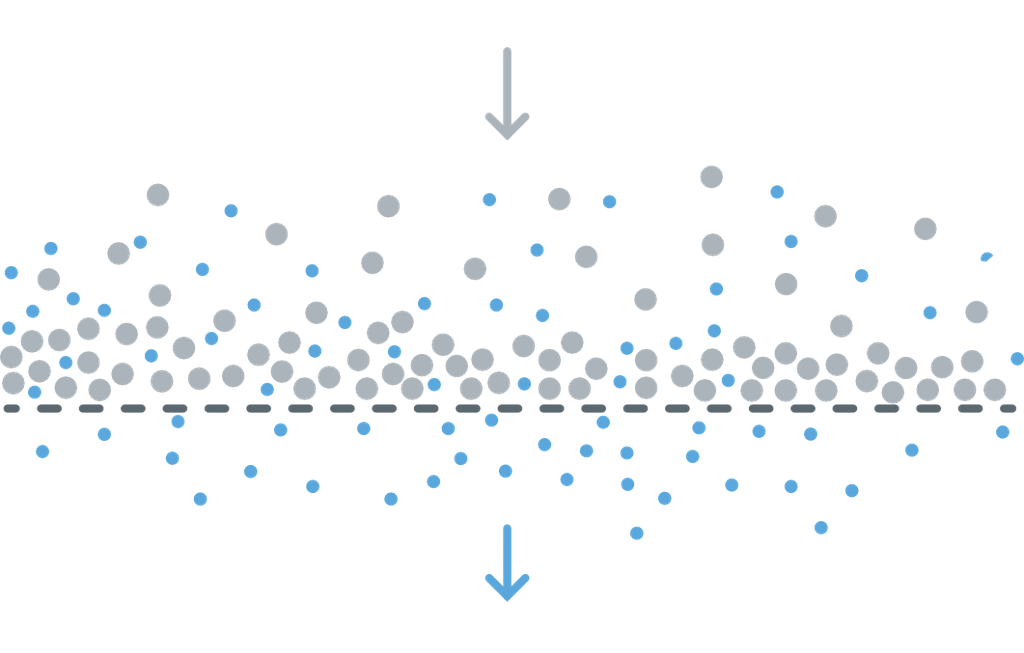
The most basic type of membrane filtration is dead-end filtration, where a liquid passes through a membrane vertically. Large particles are held back, forming a cake, while water and small particles pass through the membrane (filtrate). The challenge with this type of filtration is that a layer of particles quickly forms on the membrane surface, fouling it.
(Conventional) TFF
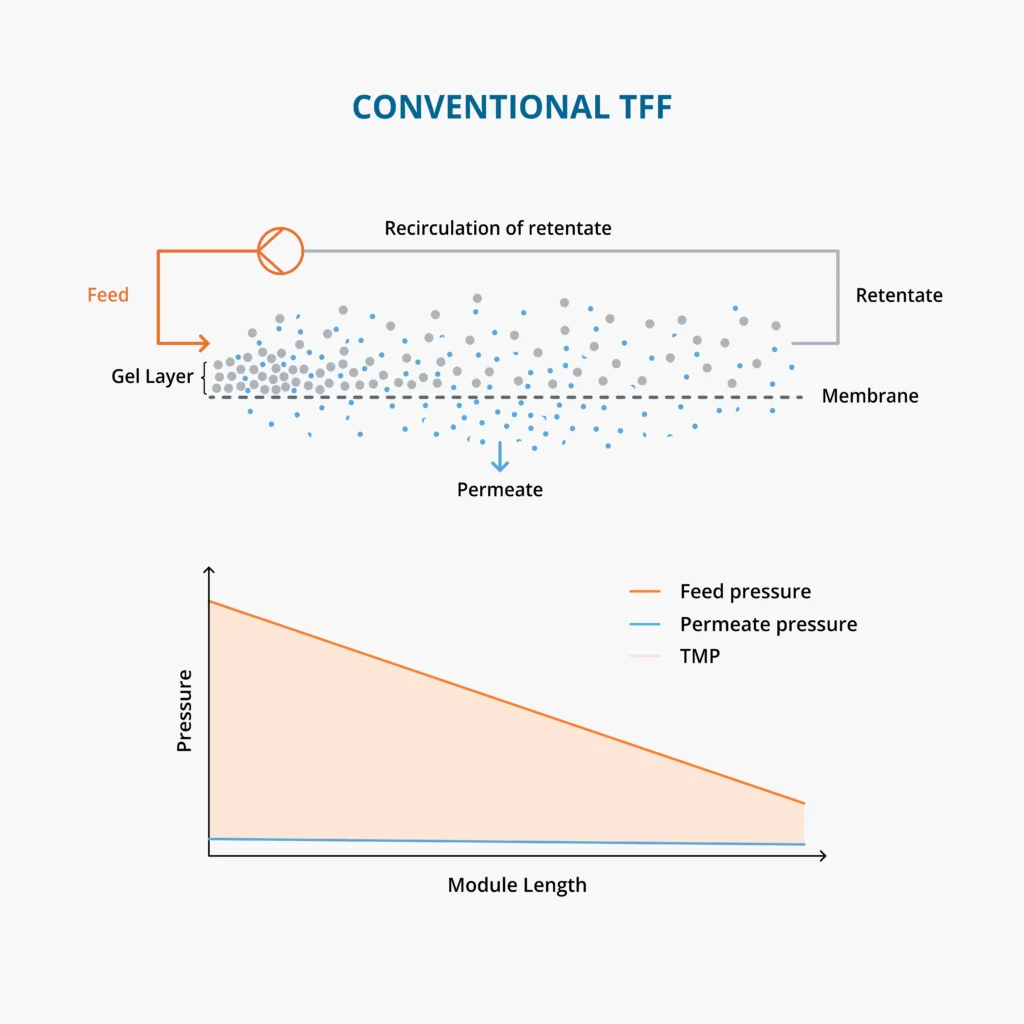
In tangential flow filtration (TFF), or crossflow filtration, the filtration medium passes the membrane horizontally. This creates turbulence along the membrane surface, which keeps particles suspended and prevents the quick and irreversible fouling common in dead-end filtration. Common examples of TFF are Hollow Fiber (HF) or flatsheet cassettes.
However, only part of a TFF membrane operates optimally due to a transmembrane pressure (TMP) drop along its length. At the inlet, pressure is high. On the positive side, this results in a high permeate flux, or amount of medium passing through the membrane. But the high pressure also cancels out the flow’s cleaning effect, which means the membrane begins to foul. At the outlet, TMP has dropped significantly due to resistance, and the opposite situation presents itself: Fouling is minimal, but permeate flux is low.
Crossflow filtration also requires shear-intensive pumping, which can damage fragile bioproducts, causing yield loss and adding impurities to the stream.
Vibro® Membrane Filtration (VMF)
Vibrations
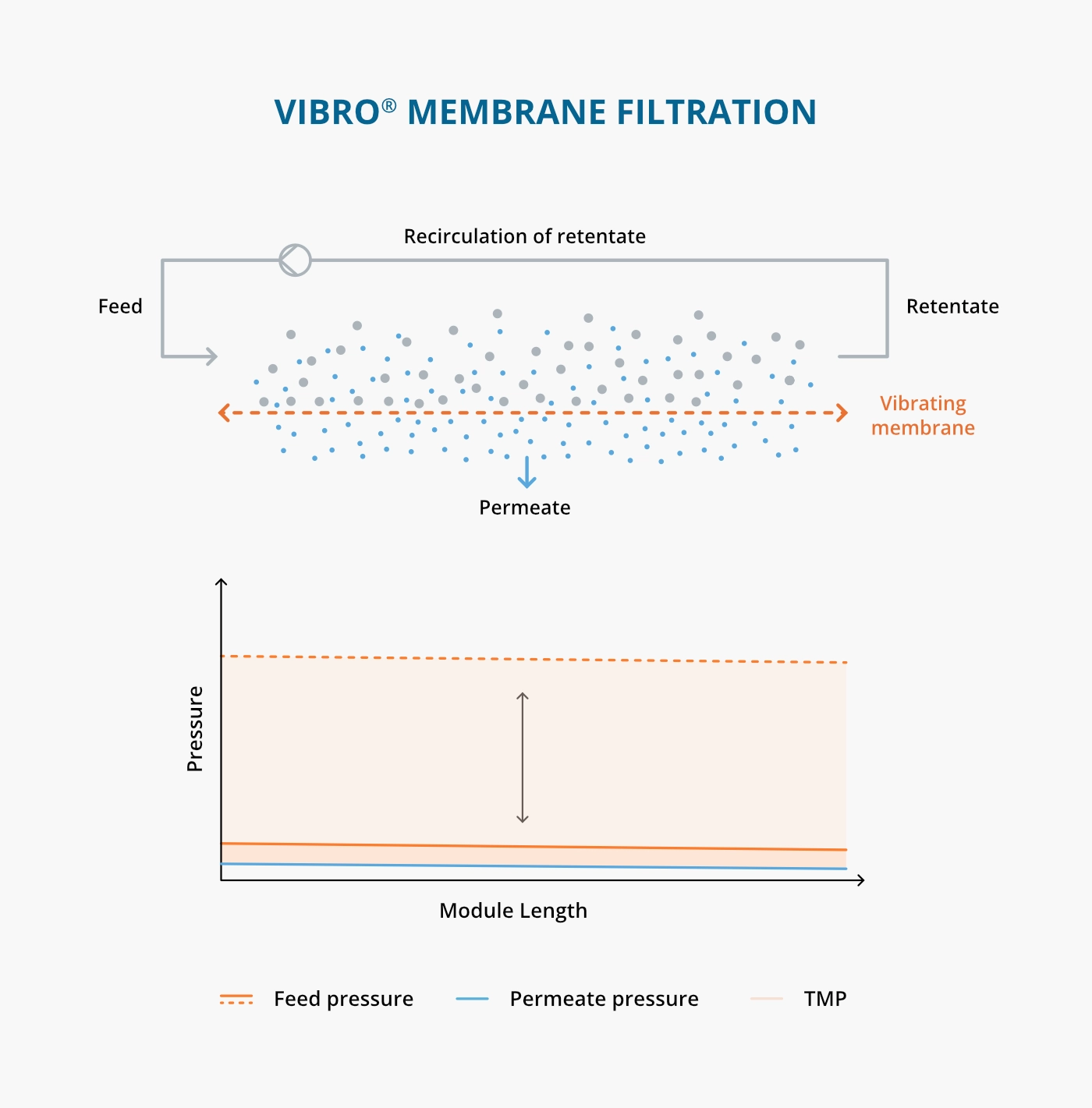
Vibro® Membrane Filtration (VMF) is the next step on the evolutionary ladder of membrane filtration, further improving upon fouling control, shear and filtration performance. VMF is a type of dynamic TFF, meaning it does not rely on crossflow alone to mitigate fouling. Instead, vibrations create the necessary turbulence on the membrane surface. This not only vastly increases fouling control, but also means VMF systems can run at much lower feed velocities than conventional TFF platforms. This makes handling high viscosities much easier. It also means pumping requirements are much lower, which has several positive side effects:
- Facility footprint is lower since pumping and cooling systems take up less space
- System shear is significantly lower, making VMF an ideal platform for sensitive biomolecules
- Cooling becomes mostly unnecessary since it is generally the intensive pumping that warms up the medium
- Energy consumption goes down by up to 90%
Transmembrane pressure (TMP) along the membrane remains uniform, which results in optimal filtration performance across its entire length. Yield, flux rates, transmission and the concentration factors that can be achieved all increase because of this. TMP can also be raised or lowered to suit specific applications, giving unique control over separation parameters.
This performance increase makes VMF uniquely capable of overcoming filtration bottlenecks, enables downstream process intensification and truly continuous processing and even allows for efficient single-step, single-pass filtration (SPTFF).
Improved Cartridge Design
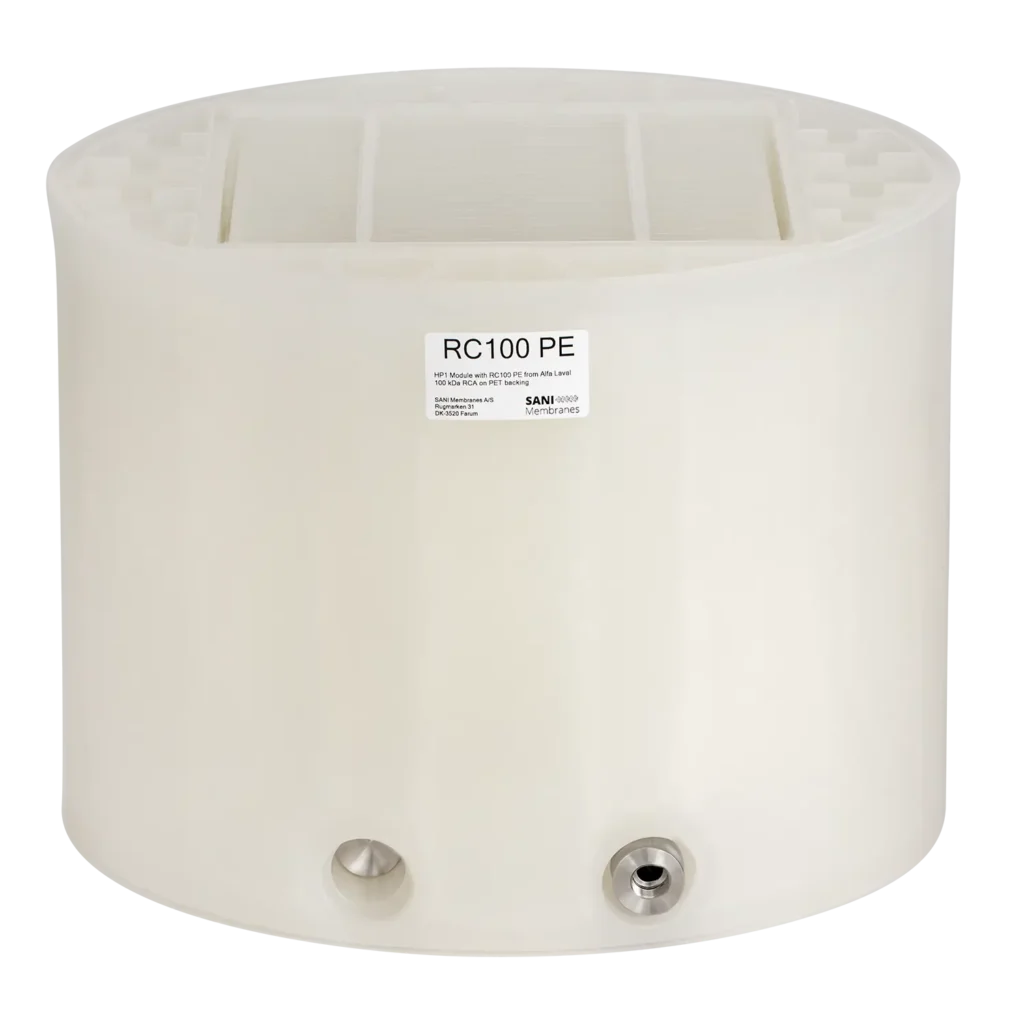
Beyond just vibrations, VMF units also differ from conventional TFF in terms of design. Similar to cassettes, membranes are welded onto filter plates, which are then stacked and assembled to form VMF cartridges. However, there is no need for support screens within a VMF filter module.
IDEAL APPLICATIONS FOR VMF
Vibro® Membrane Filtration (VMF) is particularly well-suited for bioprocessing applications where conventional TFF reaches its limits due to fouling, shear-sensitivity or high viscosities. It can also open new possibilities in micro- and ultrafiltration, from reducing the overall amount of process steps needed to achieving efficient single step, single-pass filtration.
- mRNA processing incl. LNP encapsulation
- Viral vectors (AAV, LVV)
- Monoclonal antibodies (mAbs)
- Other highly sensitive bioproducts
- Cell therapies
- Highly viscous or high-solids feeds
- Fouling-prone streams
- Continuous bioprocessing
- Process intensification
- Single-pass TFF (SPTFF)

CURIOUS TO LEARN MORE ABOUT VIBRO®?
Book a demo or discuss your application with one of our filtration specialists today.
By filling in this form, you consent to receiving digital communications from Sani Membranes.